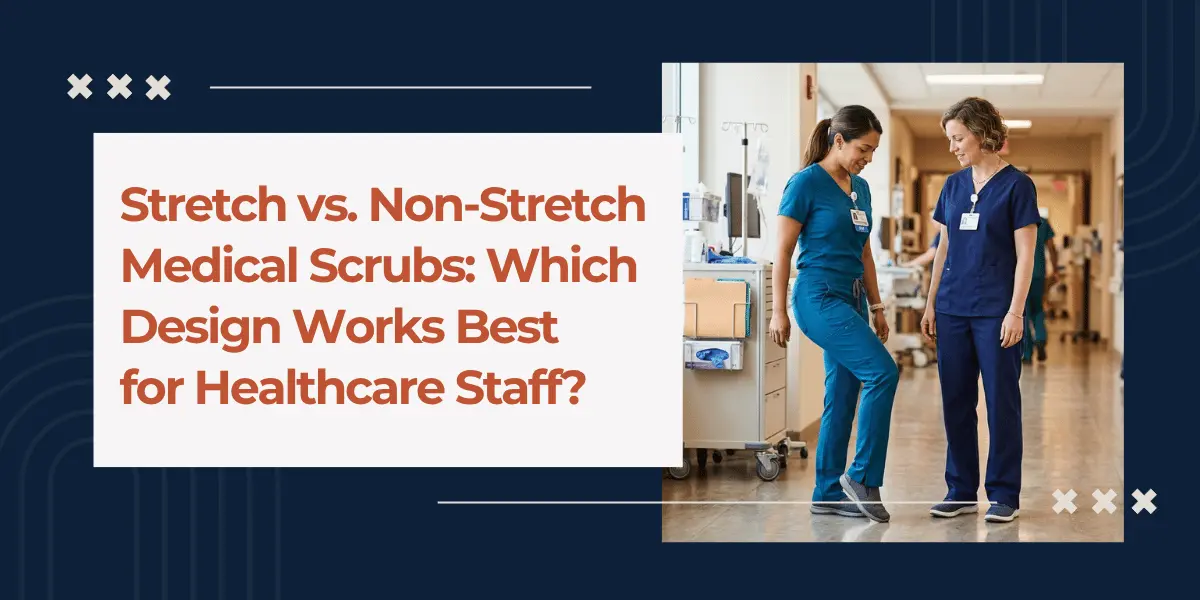
A nurse working a 12-hour shift bends, lifts, kneels, and occasionally runs, and her attire either keeps up or gets in the way. Medical scrubs must handle all of this while being clean, presentable, and cheap for the facility. The primary design decision today is whether the fabric should stretch at all.
Today, we’re looking at another important consideration: stretch vs. non-Stretch medical scrubs. Stretch workwear has become popular in healthcare over the last decade, but it isn’t suitable for every function or budget. Here’s how the two options look in practice.
What “Stretch” Actually Means?
Stretch comes from elastane (or spandex), which makes up only a few percent of the fabric by weight and is blended with polyester, rayon, or cotton. Some fabrics also have some give because of a knit construction rather than a woven one.
Non-stretch fabric is usually tightly woven polyester-cotton. It gives very little when pulled. That’s why traditional medical uniforms were made from it. Although it holds its shape well, it can restrict movement and feel uncomfortable during long shifts involving frequent bending, lifting, and stretching. Modern healthcare uniforms keep the familiar top-and-trouser format but add movement at the shoulders, waist, and knees.
What Makes A Scrub Stretch?
A little elastane (spandex), usually less than 10 percent, is mixed into polyester or cotton, or the material is knit rather than woven, to create stretch. Non-stretch fabric is typically a tightly woven poly-cotton that holds its shape and stretches very little when pulled.
That woven structure formed the basis of traditional medical uniforms. Modern nurse uniforms keep the same basic garment, but add stretch at the shoulders, waist, and knees, along with more tailored cuts.
Stretch Vs. Non-Stretch Medical Scrubs: Which Is Better?
You cannot just choose one as a win-win. It depends on what the wearer does during the day.
Stretch suits suit nurses, physios, paramedics, emergency staff, and anyone who spends their shift moving, bending, or lifting patients.
Non-stretch suits are better for jobs with less physical strain, such as lab, administration, and some pharmacy work, and facilities benefit from the lowest cost per garment.
Each garment has more stretch. Woven fabric handles repeated hot industrial washings better, and elastane can lose its recovery over time, showing up as baggy knees and seats.
Are Stretch Medical Scrubs more Comfortable for Long Shifts?
Yes, mostly active roles. Staff report less pulling through the back and shoulders, and a waistband that gives is easier to live with after a meal. However, no strong trial evidence shows that stretching prevents injury, so the argument rests on comfort and range of movement rather than health outcomes.
Quality varies widely. A cheap stretch blend might feel thin, pill quickly, and lose its shape in months, and a well-made woven garment can feel better than a poor stretch one.
Stretch hospital uniform scrubs are only more comfortable when the elastane is good, and the fit is right.
Non-stretch medical scrubs look crisp and hold up well after washing, but a fitted size can feel restrictive. Sizing up helps but leaves excess fabric that snags on equipment.
Fabrics and Finishes that Matter More Than Stretch
The three main fabric groups for medical scrubs are cotton, polyester-cotton, and polyester-rayon-spandex. Cotton breathes, but it wrinkles and shrinks. Poly-cotton is the tough compromise. Rayon mixes are soft and have good drape but may not be as hard-wearing.
Many suppliers are now incorporating antimicrobial fabric technology in healthcare lines, typically silver or zinc finishes. These inhibit odour and bacterial growth on the fabric. They don’t replace laundering, and the evidence that they reduce infection rates is mixed, so treat them as a modest extra.
How to Choose the Right Medical Scrubs for Healthcare Staff?
These are the questions you must ask before placing an order:
How physically demanding is the role? If it’s an active one, we should definitely consider fabrics that provide good stretch.
How often will the garments be washed, and at what temperatures? If they’ll undergo heavy industrial washing, woven fabrics might be the best option.
What’s the budget for each garment over the year, rather than just per purchase?
Does the climate or the temperature in the workplace suggest that we should go for a lighter fabric?
Choosing between stretch and non-stretch medical scrubs depends on staff mobility, fabric durability, laundering requirements, and budget. Stretch fabrics offer greater flexibility for nurses and emergency teams, while non-stretch options provide reliable structure for demanding wash cycles.
As healthcare workwear trends continue to evolve, facilities should prioritize comfort, breathability, and long-term value when selecting uniforms.
Silver Thread UAE helps businesses explore professional uniform solutions tailored to their workforce requirements. Before placing bulk orders, healthcare facilities should test samples, assess fabric performance, and confirm sizing consistency to keep teams comfortable, presentable, and ready for every shift.
FAQs
Can stretch medical scrubs withstand frequent industrial washing?
Yes, quality stretch scrubs can withstand frequent washing when their fabric composition and care instructions support it. Always test samples under your facility's actual laundering conditions.
How many sets of medical scrubs should healthcare employees have?
Most healthcare employees benefit from 3 to 5 sets, depending on shift patterns and access to laundry. Facilities should consider replacement needs and contamination protocols.
Should healthcare facilities choose identical scrubs for every department?
Not necessarily, because different departments have different mobility, comfort, and hygiene requirements. Coordinated colours and consistent branding can maintain a unified appearance while accommodating role-specific needs.