The fabric is the ultimate factor that makes or breaks your choice of uniform. Whether in hospitality, manufacturing, food, or construction, uniforms go through the harshest environments and even rigorous washes. So, if a fabric cannot withstand it all and still maintain its durability, it is a move toward failure.
Therefore, when you are in an industry with hectic routines, you need to ensure the right choice of fabric. This is when the role of fabric testing becomes standard, not just standard practice. But how does it matter, and what do you need to check?
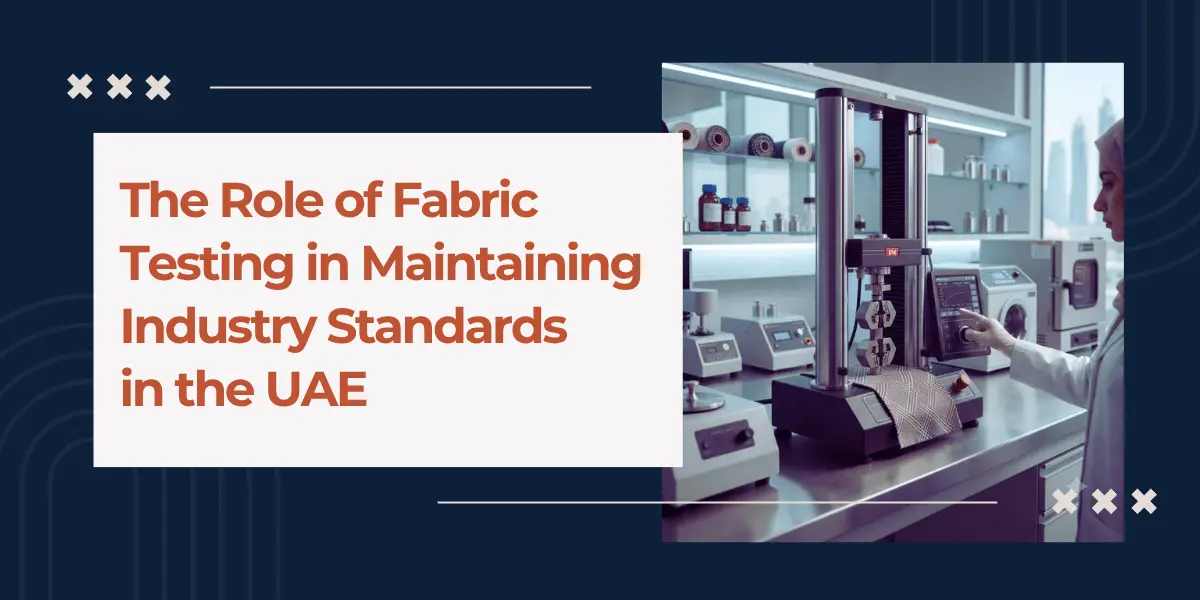
Today, we’re focusing on another critical aspect of quality workwear: the role of fabric testing in maintaining industry standards in the UAE.
Let’s explore how fabric testing ensures quality and compliance, and why it is essential for delivering durable, reliable uniforms.
Importance of Fabric Testing in the Textile Industry
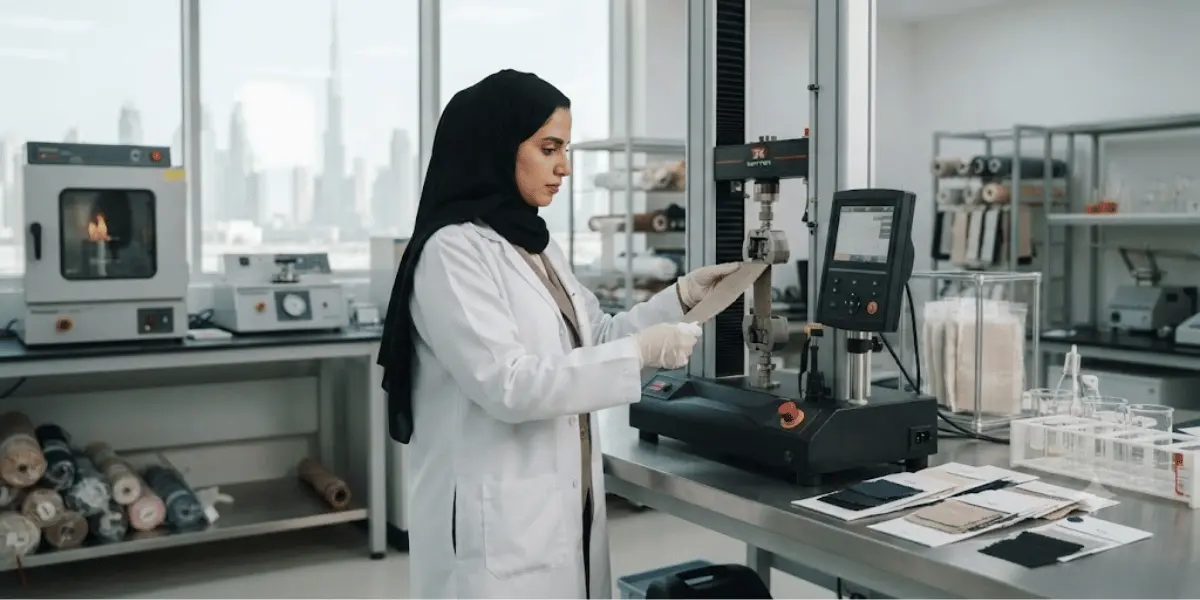
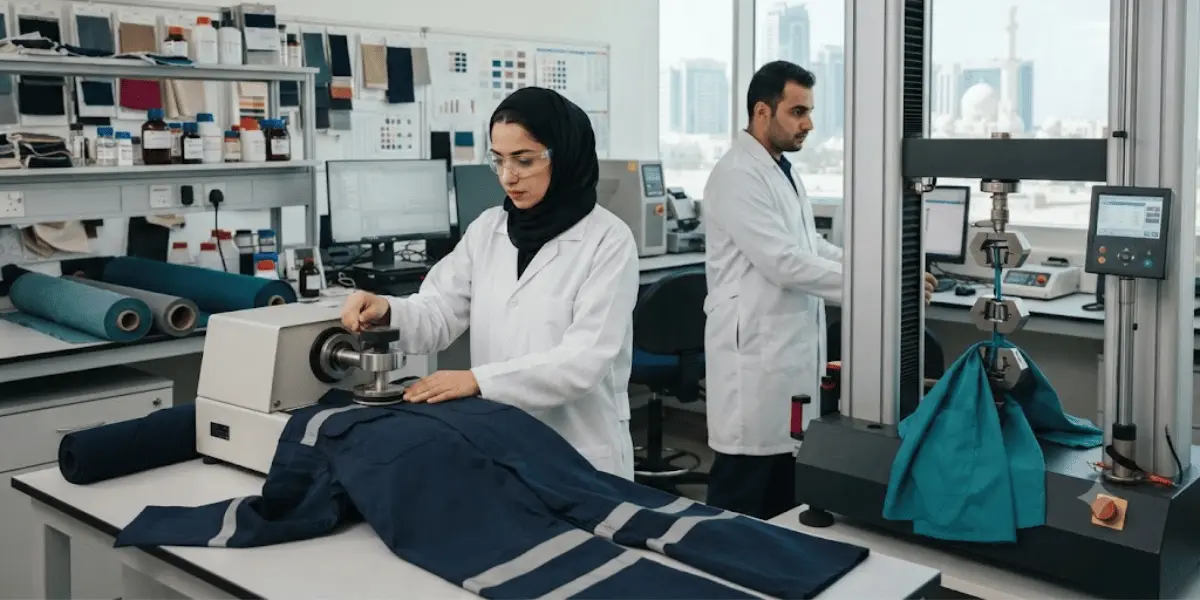
Fabric testing for uniforms in the UAE is the process of testing a textile against a series of measurable properties before it ever becomes a finished uniform. The typical tests are:
Colorfastness: Wash, sweat, light, and rubbing resistance to fading
Tensile Strength and Tear Resistance: How much stress a fabric can take before it fails.
Shrinkage Rate: Dimensional change after repeated washings
Pilling Resistance: Resistance to surface fuzzing from fabric friction
Chemical Resistance and Flammability – Essential for industrial and healthcare applications
Colour Safety: Checking for restricted dyes and chemicals under ECAS regulations
Each test represents a failure mode that could be met in practice. If a construction worker’s coverall tears under strain, it’s a safety hazard. A chef’s uniform that shrinks is a budget problem.
A sanitation issue is a nurse’s scrub bleeding its color onto other clothing in a shared laundry. That’s exactly why fabric testing is so important in the textile industry: it turns vague quality claims into pass/fail data before a single garment reaches a client.
How Does Fabric Testing Ensure Quality and Compliance?
Both documentation and performance make fabric testing a guarantee of compliance. A fabric that goes through the proper testing process carries a certificate showing the exact testing standard and its results.
This paperwork is proof of UAE fabric quality standards for uniforms under the ECAS framework. It also gives buyers evidence they can show to their clients and auditors when needed.
The 2 major standards to remember are ISO 9001 for quality management and OEKO-TEX. These are especially for industries that need chemical safety and uniform manufacturing certifications. But the certification is only as good as the testing that goes into it.
If a manufacturer is not testing the fabric and just using certification, it’s showing a credential without the substance that earned it.
How Requirements Shift: Sector by Sector
Uniform requirements can differ by sector. Therefore, the focus of fabric testing changes too. For example, healthcare uniform suppliers in the UAE need to apply different criteria than the company that makes coveralls for a warehouse environment. How does it look different for each sector? Let’s take a look.
1. Healthcare
Resistance to fluids, making it perfect for spills and bodily fluids.
An antimicrobial treatment that endures industrial washing at elevated temperatures.
Durable enough to handle regular, high-heat washing cycles.
Fast turnaround times for reorders.
A healthcare uniform manufacturer in the UAE doesn’t stop at just one fabric test. The true test of quality is whether that antimicrobial finish holds up after fifty wash cycles, not just how it performs on the first day.
2. Construction and Manufacturing
Flame-retardant treatment is essential in work environments that require it.
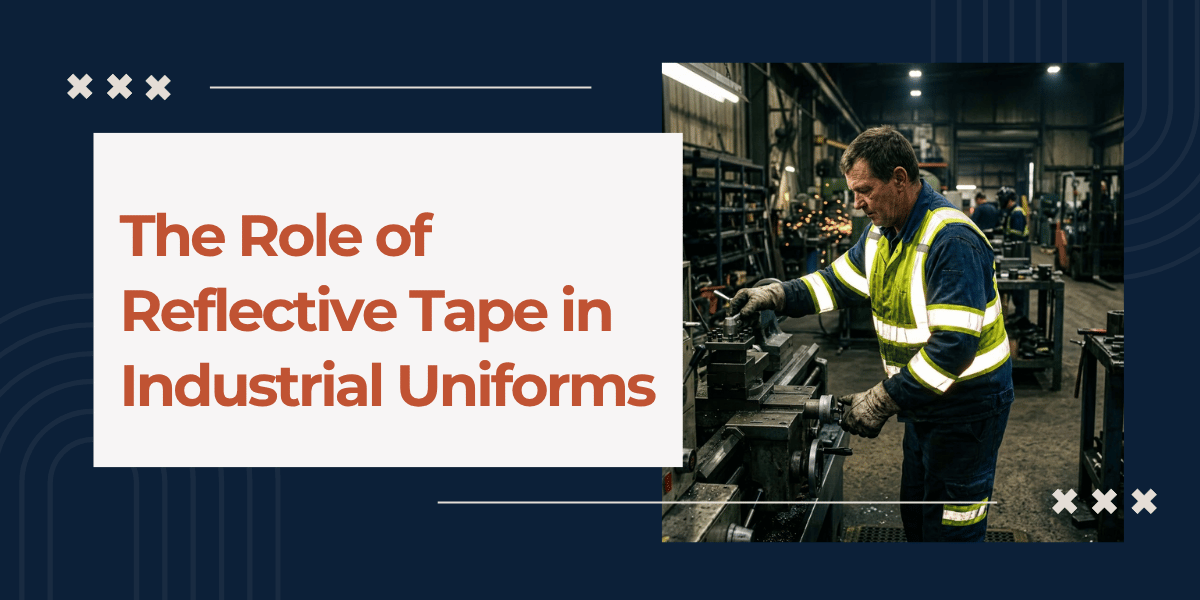
Ensuring high visibility is crucial, featuring reflective strips that have been tested for their ability to retain luminance.
Focus on tear strength, especially under repeated abrasion.
This is how one imagines industrial workwear; since a site uniform faces the challenges of every shift, it’s essential that testing reflects actual working conditions instead of just a one-time lab evaluation.
3. Hospitality
Designed to last through a full school year of active wear.
Shrink control for predictable sizing through the term.
Colourfastness for home-laundered weekly uniforms.
When hotel and food & beverage groups are purchasing for multiple properties, it’s crucial that every batch is tested consistently, not just the initial sample.
4. Education
Color uniformity between bulk dye lots
Stain Resistant
Comfort in humid, high-traffic areas
For schools ordering uniforms in bulk, consistent quality testing across every production batch helps ensure every student receives the same standard of durability, comfort, and finish.
They should withstand frequent industrial washing without showing signs of wear.
Additionally, the dyes and finishes must adhere to safety limits for hygiene-related chemicals.
Even if the garment doesn’t come into direct contact with food, it still needs to align with food-contact hygiene standards to maintain a safe environment.
6. Automotive
Resistant to oil and chemicals.
Resistant to abrasion from repeated movement and contact with tools.
Flame retardant properties where required by role.
It is in precisely these conditions that automotive uniforms for service centers and production lines are tested, not under generic workwear standards.
Conclusion
Fabric testing is the foundation of high-quality uniforms, ensuring they meet the durability, safety, and performance standards required across different industries. From healthcare and hospitality to construction and manufacturing, proper testing helps businesses invest in uniforms that perform reliably every day.
The company provides a wide range of uniform customization options to meet different branding and operational requirements. By combining quality fabrics with expert craftsmanship, Silver Thread UAE delivers uniforms that support both performance and compliance standards.
FAQs
Why is fabric testing important for uniforms?
Fabric testing verifies durability, comfort, colourfastness, and safety before uniforms are manufactured. It also helps ensure compliance with industry standards and quality requirements.
What fabric tests are commonly performed on work uniforms?
Common tests include shrinkage, tear strength, colourfastness, pilling resistance, and chemical or flame resistance. The required tests vary depending on the industry and application.
Where can I buy customized uniforms in the UAE?
Silver Thread UAE is a trusted uniform manufacturer in the UAE offering high-quality corporate and industrial uniforms. They provide professional uniform customization options for businesses across multiple industries.