

Uniform Colour Codes In UAE Hospitals And Their Importance

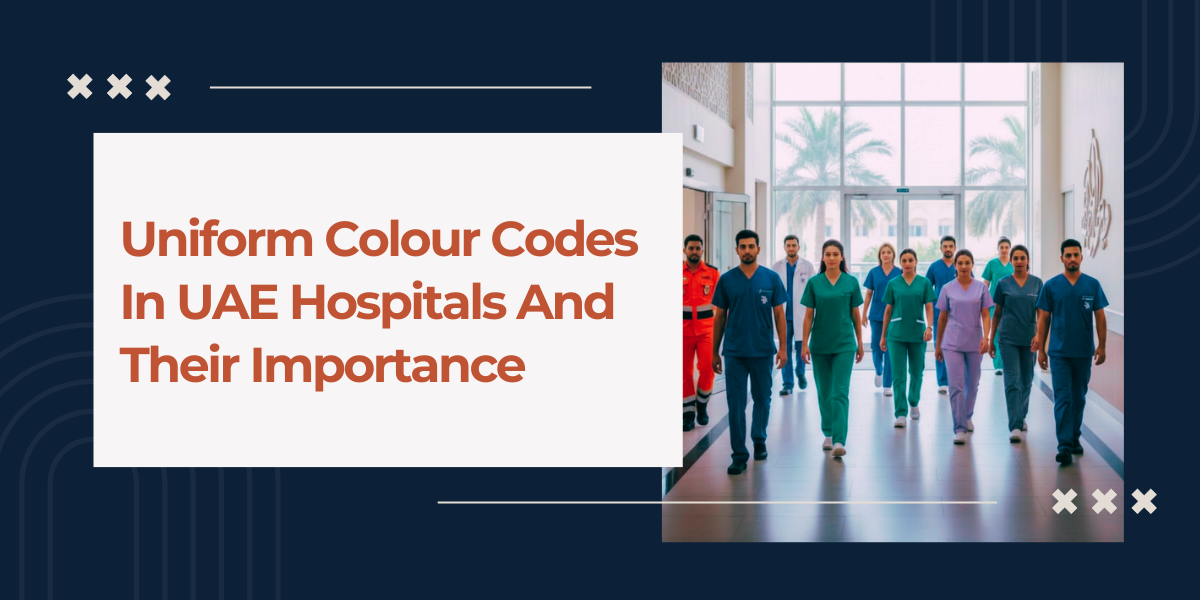
Instead of following a single national standard, hospitals in the UAE choose their own uniform colour schemes. Previously, we explored the differences between medical scrubs and lab coats and dived into the evolution of healthcare uniforms.
Today, we will talk about uniform colour codes in UAE hospitals and why they matter in clinical environments. Hospitals must adhere to professional dress codes and hygiene standards set forth by federal and emirate health regulators (MOHAP, DHA, and SEHA/DOH); however, they are not required to use particular colours for staff uniforms.
In keeping with infection-control guidelines (sterile green/blue scrubs in surgery), Dubai’s government hospitals also use colour-coded scrubs, along with antimicrobial fabric technology, in healthcare. For example, maternity ward staff wear blue, while operating room teams wear green.
Private hospital chains, such as Cleveland Clinic Abu Dhabi, Mediclinic, NMC Healthcare, and Aster DM Healthcare, typically adhere to international standards. Support staff usually wear facility-specific colours; nurses commonly wear light blue or green; and doctors typically wear white coats or dark/navy scrubs.
So, what are the exact uniform colour codes in UAE hospitals? Well, we will find out in this article.
Regulatory and Policy Context for Colour Codes in UAE Hospitals
Hospital employees are not required to wear the UAE hospital uniform colour codes under any federal regulation.
Health officials instead concentrate on infection prevention and dress code regulations. According to Abu Dhabi’s DOH (formerly HAAD) and the private health regulator (DGPHE), facilities must establish a dress code, ensure uniforms are clean, and ensure all employees are clearly identifiable by their uniforms and badges.
Similarly, MOHAP’s Unified Hospital Regulation (2018) places strong emphasis on quality and safety but makes no mention of colour. By ensuring that uniforms, typically hospital-issued scrubs or coats, are laundered and replaced regularly, infections and contamination are controlled.
In short, UAE authorities require hygienic, professional attire (such as sterile gowns in the operating room), but they leave colour selection to each hospital’s internal policies.

Importance of Hospital Uniforms in the UAE
While there may not be one rule for all, the meaning of medical uniform colourin hospitals still holds importance and purpose. Colour coding helps patients quickly identify roles, improves internal coordination among staff, and supports infection-control protocols.
In the UAE, many healthcare facilities work closely with hospital uniform manufacturers to design colour-coded uniforms that align with branding, hygiene regulations, and international healthcare standards.
Beyond branding considerations, uniform colours in UAE hospitals serve several important practical and functional purposes. Let’s explore these factors below.
-
Staff Identification & Patient Safety:
Patients, guests, and employees can easily identify carers by their distinct role-based uniform colours. It is known that absence of uniforms, patients often fail to differentiate nurses from physicians or other employees.
Unauthorised access to restricted areas can be prevented, and confusion (e.g., not knowing whom to call for assistance) can be reduced through clear visual differentiation.
Staff roles become instantly identifiable through a uniform programme that designates colours by discipline (for example, light blue for doctors and navy for nurses). By ensuring that, with the help of uniform manufacturers in the UAE, safety is always prioritised.
-
Infection Control:
One important infection-control strategy is to wear hospital-specific uniforms rather than your own clothes. To prevent the spread of pathogens, lab coats and hospital scrubs should be laundered at high temperatures and replaced when soiled.
Colour-coded hospital scrubs (for example, green surgical scrubs laundered in accordance with OR protocol) also help enforce these rules. Hospitals can further control the risk of contamination by assigning colours to particular areas (OR, ICU, wards) (e.g., lab coats in wards vs. sterile gowns in theatre).
-
Operational Efficiency & Team Coordination:
There is also a role of psychology of colour in healthcare uniforms. Quick role identification facilitates workflow in busy hospitals. Teams can quickly identify one another and coordinate tasks when every department or staff level has a standard colour. During rounds, for instance, a charge nurse can identify other nurses wearing blue scrubs.
On the other hand, guests or non-clinical staff wearing different clothing, for example, housekeeping in pink or purple, are easily identified on the incorrect floor. When quick team assembly is essential during emergencies and disasters, standardised colours also help.
-
Professional Image & Branding:
A consistent, unified colour scheme conveys a polished, well-organized image. Standardised uniforms bearing the hospital’s logo serve to communicate expertise and strengthen brand identity.
Coordinated, modern healthcare uniforms are often perceived by patients as an indicator of high-quality care. On the other hand, disorganised or poorly fitting clothing can make one appear less confident.
Even hospital branding can benefit from uniform colour schemes (e.g., using corporate colours or colour accents to match logos). As a result, colour-coding enhances the hospital’s public image in addition to its functional uses.

Summary of Roles and Typical Colours
Based on examples from major public and private systems, the table below lists common roles in UAE hospitals, along with the colours typically used for their uniforms.
| Staff Role | Example (Abu Dhabi, SSMC) | Example (Dubai, Al Wasl Women’s H.) | Typical Private Hospital |
| Consultant/Resident Doctors | Blue scrubs or a white coat | White coat over scrubs; (surgery: green) | White coat or navy scrubs |
| Registered Nurse (RN) | Royal blue scrubs | Light blue scrubs (maternity) | Light blue or navy scrubs |
| Practical Nurse/Assistant Nurse | Caribbean blue scrubs | (Often the same as RNs or teal in some wards) | Light blue or green scrubs |
| OR Nurse / Surgical Tech | Light blue surgical scrubs | Green sterilized scrubs | Green or blue scrubs |
| Allied Health (PT, Lab, Rad) | Gray scrubs (or lab coat) | White lab coat or light scrubs | Gray/white lab coat or colored scrubs |
| Pharmacist | Purple scrubs | White lab coat or a distinct colour | White coat or purple/violet |
| Nursing Assistant / Aide | Teal scrubs | (Often pink or maroon in UAE hospitals) | Bright colours (e.g. teal, pink) |
| Unit Clerk / Reception | Submarine (dark navy) | (Often maroon or navy uniform) | Branded tunic or formal attire |
| Housekeeping/Cleaning Staff | (Not specified at SSMC) | (Many hospitals use magenta or violet) | Often pink, orange or maroon scrubs |
| Admin/Management (non-clinical) | Business attire or badge ID | Business attire or polos | Branded polo or business wear |
Conclusion
Uniform colour codes in UAE hospitals may not follow a single national standard, but they play a vital role in ensuring clarity, safety, and professionalism.
From infection control to staff identification and branding, carefully selected colours enhance both operational efficiency and patient confidence. Healthcare facilities looking to buy customized uniforms in the UAE should work with experienced uniform suppliers that understand regulatory and hygiene requirements.
For hospitals sourcing bulk hospital scrubs in the UAE, partnering with trusted providers such as Silver Thread UAE ensures high-quality fabrics and consistent colour schemes. Also, their durable designs meet the evolving needs of modern healthcare environments.
FAQs
-
What are the standard uniform colour codes in UAE hospitals?
There is no single national colour standard across UAE hospitals. Each facility assigns colours based on department roles, infection-control requirements, and internal branding preferences.
-
Why are uniform colour codes important in hospitals?
Uniform colour codes improve patient safety and reduce confusion. They also support infection control and operational efficiency and reinforce a professional healthcare environment.
-
How do uniform colours help identify hospital staff roles in the UAE?
Different colours are assigned to specific departments or job roles. This allows patients and staff to instantly recognise doctors, nurses, technicians, and support personnel.